


Biographical notes
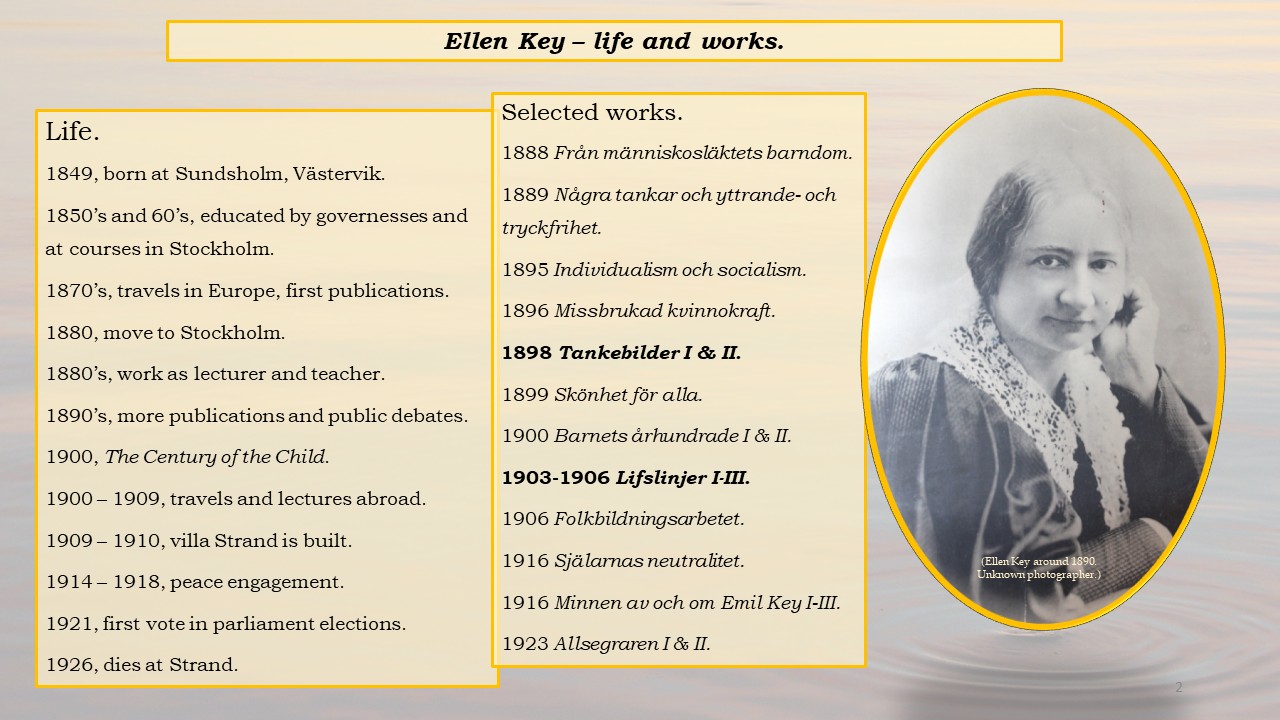
Ellen Key was born in 1849 at the manor Sundsholm in Småland, Sweden, the eldest of six children in a family where liberal convictions coexisted with strict discipline. Her father Emil was a politician, member of parliament and landowner, her mother Sophie from the aristocratic Posse family. Sundsholm, with its library, art and lakeside setting, became a formative paradise for Ellen, nurturing her love of books and aesthetics while also exposing her to a rigid upbringing. This contrast between discipline and freedom deeply marked her later reflections on childhood and education.
Educated at home by foreign governesses, Ellen soon accessed the family library, reading widely in several languages. Encouraged by her parents’ political discussions, she developed an early passion for literature and political and societal ideas. During adolescence she underwent a period of religious questioning, moving from conventional Christianity to a personal philosophy she called “Life Faith”, inspired by evolutionism, monism, and the works of Goethe and Spinoza. In the 1860s she began assisting her father in parliamentary work and initiated teaching at Sundsholm. Later in Stockholm she collaborated with Anna Whitlock in founding a progressive school that practiced coeducation, emphasized learning by doing and rejected compulsory studies in Christianity. Through journalism, lectures and essays, she became part of Sweden’s radical milieu, befriending feminists and social reformers. Travel in Europe broadened her outlook and strengthened her belief in the cultural and educational power of art and beauty.
From the 1880s onwards, Key established herself as a lecturer and author. Her major work The Century of the Child (Barnets århundrade1900) brought her international fame and was quickly translated and widely discussed.
In 1910 she settled at Strand on Lake Vättern, a house designed to embody simplicity, harmony and domestic beauty. Strand became her retreat and intellectual meeting place, later donated to a foundation to provide a summer guest house for working women. Throughout her life she remained a convinced pacifist, condemning nationalism and war while envisioning a European community built on peace and education.
Ellen Key died at Strand in 1926. Celebrated alongside Strindberg and Lagerlöf as one of Sweden’s most famous authors, she left a lasting legacy in the history of childhood, women’s rights and educational thought.
As a header image, a photomontage composed of three silhouettes of Ellen Key: from left to right, Ellen Key 1855, Ellen Key 1895, and Ellen Key 1908.